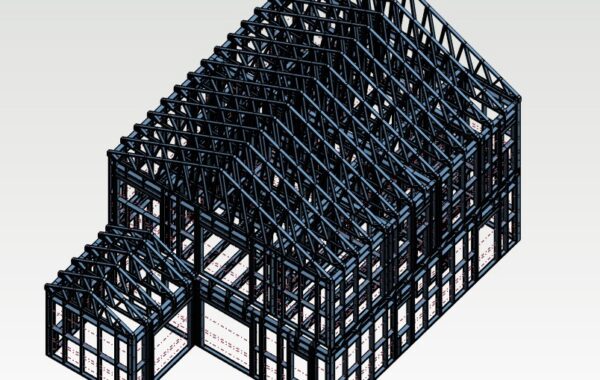

What four years of pursuing residential steel framing taught me about patience, compounding, and building something that may take years to work.
There is a strange psychological challenge that comes with pursuing an idea before the market is ready for it.
You can spend years working on something that you genuinely believe in while receiving very little external validation.
There may be a few people who understand what you’re doing. There may be occasional encouragement, an article, a conference invitation, a new relationship, a promising conversation.
But most of the market continues doing exactly what it has always done.
In residential construction, that is particularly obvious.
Lumber yards dominate the market. Builders have established suppliers, crews, processes, pricing systems and relationships built around wood framing. Most builders don’t wake up thinking about changing the fundamental way they frame houses.
Residential steel framing remains a very small part of the market.
I’ve known that for years.
And I’m still here.
Not because I think change happens quickly.
Because I think the opposite.
Real change usually takes much longer than we expect — and the people who benefit from it are often working on the problem long before everyone else decides it matters.
Four Years In
I’ve now been working on residential steel framing for about four years.
When I look at that number by itself, it’s easy to ask:
Where is this supposed to be by now?
But I’ve realized that is the wrong question.
A better question is:
What exists today that didn’t exist four years ago?
The answer is a lot.
I’ve built ResidentialSteelFraming.com.
I’ve developed a catalog of nine residential home plans.
I’ve worked through engineering, BIM models, material takeoffs, pricing, estimating and procurement.
I’ve built relationships with manufacturers, engineers, builders, developers and people throughout the framing industry.
I’ve had my work recognized and published.
I’ve been fortunate enough to have an offsite construction publication describe me as an urban pioneer.
I’ve built an audience around the company.
I’ve written articles and technical resources.
I’ve developed construction budgets for the plans.
I’ve learned how to translate a residential design into something that can eventually become a repeatable construction product.
And I’ve continued learning what builders actually need — not what I wish they needed.
None of these things, by itself, looks like a breakthrough.
Together, they are an asset base.
The Asset Is More Than the Company
This has probably been the biggest shift in my thinking.
I used to look at progress primarily through the lens of business results.
Revenue.
Customers.
Projects.
Deals.
But a long-duration business doesn’t work that way in the beginning.
You are accumulating capabilities.
Knowledge is an asset.
Relationships are an asset.
A website is an asset.
A database is an asset.
A standardized estimating system is an asset.
A library of house plans is an asset.
A documented process is an asset.
A reputation is an asset.
A building is an asset.
A license is an asset.
Even a failed experiment can become an asset if you document what you learned.
The challenge is that many of these assets don’t show up clearly on a monthly income statement.
That doesn’t mean they aren’t compounding.
I Started Documenting the Small Wins
About a year ago, I realized how much was happening in my life that I was immediately forgetting.
One week I might be working on a construction project.
The next week I’m meeting with an architect.
Then I’m analyzing a development site.
Then I’m working on a steel framing plan.
Then I’m studying for a license.
Then I’m cleaning a 70,000-square-foot industrial building in Detroit.
Then I’m building a software prototype.
Then I’m working in someone’s bathroom to generate cash.
Then I’m back to studying land.
Then I’m talking with a builder.
Then I’m working on a budget.
It can feel chaotic when you’re living it.
So I started keeping weekly and monthly recaps.
Looking back at them has changed my perspective.
I can see things that aren’t obvious when I’m living from one week to the next.
The small wins were accumulating.
The Work Didn’t Look Like a Straight Line
My path has not been:
Steel framing → customers → revenue → scale.
It has looked more like:
Construction → real estate → development → steel framing → engineering → estimating → land analysis → preconstruction → software → AI → Detroit development → manufacturing → standardized housing.
At first glance, that can look unfocused.
But there is a common thread.
I’m increasingly interested in controlling more of the development process.
How do we find the right land?
How do we understand the zoning?
How do we determine whether the project works financially?
How do we design the right product?
How do we estimate it accurately?
How do we engineer it?
How do we manufacture it?
How do we get it to the jobsite?
How do we build it?
How do we repeat it?
That’s a much bigger question than whether a wall is framed with steel or wood.
Steel happens to be one of the technologies I’m betting on along the way.
Construction Is Currently Funding the Future
There is another lesson I’m learning that I think is important.
Not every activity has to be the final destination.
Right now, I take construction work.
Some of it is sophisticated.
Some of it is not.
I’ve done demolition, commercial buildouts, bathroom renovations, cleanouts, repairs and other construction work.
It would be easy to look at that and think:
“You’re supposed to be building a steel-framing company. Why are you doing this?”
Because the bills still need to be paid.
And because construction is also teaching me.
Every job teaches me something about labor, sequencing, materials, subcontractors, estimating, scheduling and the reality of getting work completed.
I’m increasingly comfortable with the idea that my current work doesn’t have to be my final business model.
It has to support the next one.
Construction generates cash.
The systems generate capability.
The products create leverage.
The development creates ownership.
Those are different functions.
The Goal Is Not to Work Harder
I’ve never had much trouble working.
My problem is more likely to be working on too many things.
That’s an important distinction.
When you have a lot of interests and opportunities, it is easy to confuse activity with progress.
Another meeting.
Another website.
Another software prototype.
Another social media post.
Another business idea.
Another property.
Another plan.
Another partnership.
At some point you have to ask:
Does this compound?
I’ve started using three questions:
Does this create cash? If so, it helps create financial stability.
Does this create capability? If so, it makes me better at something important.
Does this create an asset? If so, it may continue producing value after the work is finished.
The best activities do more than one.
The Risk I’m Watching Now
There is another side to compounding that I have to be honest about.
Doing more does not automatically mean I’m making more progress.
Looking through my own weekly records makes that obvious.
I have worked on steel framing, real estate, development, construction, software, AI, land analysis, websites, content, licensing, nonprofit work and a dozen other things.
Some of those activities are directly connected.
Some are only indirectly connected.
Some probably don’t deserve my attention anymore.
That’s something I’m becoming much more disciplined about.
The next phase isn’t about seeing how much I can carry.
It’s about deciding what deserves to compound.
I want fewer disconnected efforts and more connected ones.
If I spend time learning construction estimating, that should make me a better builder.
If I build a better estimating system, it should make my steel-framing business more scalable.
If I study Detroit land, it should make me a better developer.
If I build relationships with builders and developers, those relationships should eventually create opportunities for projects.
If I document what I’m learning, that knowledge should become content, systems and eventually intellectual property.
If I earn money through construction, some of that money should create the runway to pursue the larger opportunity.
The objective isn’t simply to accumulate accomplishments.
It’s to make the accomplishments reinforce one another.
That’s the difference between being busy and building something.
What I’m Learning About Building Something Long-Term
I think there is a difference between having a lot of interests and building a lot of things.
The difference is whether the work connects.
If you are pursuing something that may take years, you cannot expect every year to look like a breakthrough year.
Some years are about learning.
Some are about building relationships.
Some are about surviving.
Some are about accumulating capital.
Some are about developing a product.
Some are about making mistakes that you don’t want to make again.
The important question is whether those years are making the next year more productive.
That has become one of the ways I think about my own work.
I don’t need every project to become a company.
I don’t need every idea to become a product.
I don’t need every relationship to become a deal.
I don’t need every year to produce a dramatic result.
But I want the things I spend my time doing to increase my ability to do the next important thing.
That might mean learning how to estimate a house more accurately.
It might mean understanding Detroit land better.
It might mean developing a better construction process.
It might mean building a relationship with someone who knows something I don’t.
It might mean earning enough money to give myself another year of runway.
It might mean documenting something well enough that I never have to figure it out from scratch again.
Those things don’t always feel significant in the moment.
But they change what I’m capable of doing next.
That’s the kind of progress I’m trying to measure now.
My Detroit Chapter
My move into Detroit has made this even more interesting.
I’m increasingly focused on the intersection of land, housing and construction.
I’ve been studying vacant lots, zoning, neighborhood conditions, NEZ districts, comparable new construction, taxes, utilities, site conditions and development economics.
The goal isn’t simply to find cheap land.
It’s to understand:
What can actually be built here, who will buy it, what will it cost, and can the numbers work?
That process is forcing me to become a better developer.
And it is giving my steel-framing work a real-world laboratory.
Instead of endlessly talking about how steel could change residential construction, I want to eventually build houses and measure what actually happens.
That’s a much better argument.
Bellevue
There is another piece of this story that I don’t fully know the ending to yet.
I own a 70,000-square-foot industrial building in Detroit.
It needs work.
A lot of work.
But I see the possibility of something much larger there over time.
It could eventually become headquarters, manufacturing space, training space, a fabrication facility, workforce development space, or some combination of things I haven’t thought of yet.
I’m not trying to force that answer today.
For now, I’m making the building more useful.
Power.
Security.
Cleanup.
Lighting.
Access.
Basic infrastructure.
Preserving the option.
That’s another lesson I’m learning:
Sometimes the job isn’t to know exactly what an asset will become. The job is to keep improving it until the future gives you more options.
Why I’m Still Excited
The easiest conclusion would be:
“Four years and the industry hasn’t changed. Maybe the idea doesn’t work.”
I don’t see it that way.
I think residential construction has enormous inertia.
Builders have built their businesses around existing systems.
Suppliers have built distribution around existing materials.
Trades have developed habits around existing construction methods.
Building departments have processes.
Homebuyers have expectations.
Changing that ecosystem is difficult.
That doesn’t mean it can’t change.
It means changing it requires more than a good product.
It requires proof.
Builders need to see projects.
They need pricing.
They need installation experience.
They need engineering.
They need suppliers.
They need trained crews.
They need confidence.
They need someone to make the transition easier.
That is a much longer journey than posting another article saying:
“Steel is better than wood.”
I’m increasingly less interested in convincing people.
I’m more interested in building the evidence.
Early Is Uncomfortable
There is a major psychological difference between being early and being wrong.
When you’re early, the market doesn’t provide much feedback.
That’s uncomfortable.
You don’t get the satisfaction of being obviously right.
You don’t have hundreds of competitors validating your idea.
You don’t have a mature supply chain.
You don’t have thousands of case studies.
You have to keep learning while the market is still skeptical.
But there is an advantage.
If the market eventually moves in your direction, you have accumulated years of knowledge while everyone else is beginning to learn.
You know the mistakes.
You know the suppliers.
You know the problems.
You know what builders ask.
You know what doesn’t work.
You have relationships.
You have products.
You have documentation.
You have credibility.
Being early gives you time to build the playbook.
The Next Stage Is Different
I don’t think my job now is to create more ideas.
I’ve created enough.
The next stage is consolidation.
Take the nine home plans and make them increasingly complete.
Take the estimating system and make it repeatable.
Take the land research and turn it into a process.
Take the preconstruction knowledge and turn it into an operating system.
Take the steel framing knowledge and turn it into actual projects.
Take the projects and document them.
Take the documentation and turn it into proof.
Take the proof and turn it into customers.
Take the revenue and turn it into capital.
Take the capital and turn it into ownership.
Then repeat.
Build. Document. Learn. Standardize. Repeat.
That’s probably the simplest way I can describe the next chapter.
Build something real.
Document what happened.
Learn from it.
Standardize what works.
Repeat it.
Every project should make the next project easier.
Every mistake should become part of the system.
Every relationship should increase the network.
Every dollar of surplus should increase runway.
Every hour spent learning should increase capability.
Every completed product should become an asset.
That’s what compounding looks like before it becomes visible.
I’m Not Trying to Win Overnight
I used to think more about how quickly something should happen.
Now I’m increasingly interested in whether I’m building something that could still matter ten, twenty or thirty years from now.
Great businesses aren’t necessarily built in a year.
Some are built across generations.
That doesn’t mean moving slowly.
It means thinking in longer time horizons while executing relentlessly in the present.
Right now I’m trying to:
Stay solvent.
Keep learning.
Build real things.
Create useful products.
Develop land expertise.
Build relationships.
Document the work.
Improve my systems.
Save capital.
And continue moving toward ownership.
I don’t know exactly what Residential Steel Framing will become.
I don’t know exactly what Bellevue will become.
I don’t know exactly what the Detroit development business will become.
I don’t think I need to know yet.
I need to keep building the capabilities that give me the ability to take advantage of whatever comes next.
The Compound Interest of a Life
The most valuable thing I’ve learned from keeping these weekly and monthly records is that progress is often invisible while you’re making it.
A license doesn’t look like much on a Tuesday afternoon.
Neither does a new home plan.
Neither does a database.
Neither does a relationship.
Neither does a cleaned-up warehouse.
Neither does a finished budget.
Neither does an article.
Neither does a construction job that simply pays the bills.
But stack enough of those things together and eventually you have something different.
You have capability.
You have assets.
You have optionality.
You have reputation.
You have capital.
You have knowledge that other people don’t have.
And eventually, if you keep going long enough, those things can begin to reinforce one another.
I don’t know if residential steel framing will become the industry I believe it can become.
I don’t know exactly what Bellevue will become.
I don’t know which of today’s ideas will still exist five years from now.
And I don’t think I need to know.
What I do know is that I am much more capable today than I was four years ago.
I know more about construction.
I know more about development.
I know more about land.
I know more about estimating.
I know more about business.
I know more about technology.
I know more people.
I own more assets.
I’ve built more systems.
And I have a much clearer understanding of what I don’t know.
Maybe that’s what compounding really looks like in the early stages.
Not explosive growth.
Not overnight success.
Just becoming incrementally more capable of building the thing you believe should exist.
So I’m going to keep going.
Not because I know exactly how the story ends.
But because I believe the work I’m doing today gives me a better chance of being ready when the opportunity arrives.
Build. Document. Learn. Standardize. Repeat.
The market may take a long time to move.
I’m willing to take the long view.
For now, the work continues.